We’ve all heard the old saying, You can’t add apples and oranges (Fig. 7–3).
This is actually a simplified expression of a far more global and fundamental
mathematical law for equations, the law of dimensional homogeneity,
stated as
Every additive term in an equation must have the same dimensions.
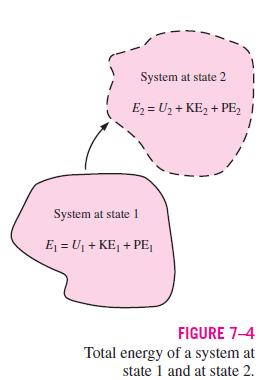
Consider, for example, the change in total energy of a simple compressible
closed system from one state and/or time (1) to another (2), as illustrated in
Fig. 7–4. The change in total energy of the system ( E) is given by Change of total energy of a system:

where E has three components: internal energy (U), kinetic energy (KE), and potential energy (PE). These components can be written in terms of the system mass (m); measurable quantities and thermodynamic properties at each of the two states, such as speed (V), elevation (z), and specific internal
energy (u); and the known gravitational acceleration constant (g),

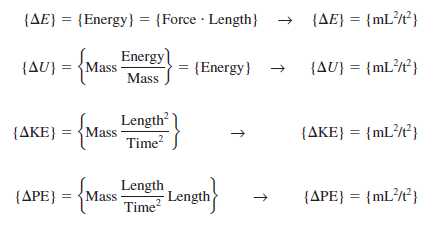
m2/s2, all of which are equivalent. Suppose, however, that kJ were used in place of J for one of the terms. This term would be off by a factor of 1000 compared to the other terms. It is wise to write out all units when performing mathematical calculations in order to avoid such errors.

SOLUTION We are to verify that the primary dimensions of each additive term in Eq. 1 are the same, and we are to determine the dimensions of constant C.
Analysis (a) Each term is written in terms of primary dimensions,
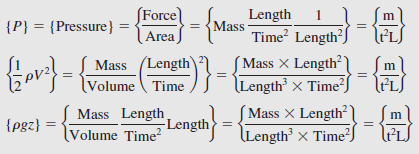
Indeed, all three additive terms have the same dimensions. (b) From the law of dimensional homogeneity, the constant must have the same dimensions as the other additive terms in the equation. Thus,
Primary dimensions of the Bernoulli constant: 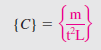
others, it would indicate that an error was made somewhere in the analysis.
Nondimensionalization of Equations The law of dimensional homogeneity guarantees that every additive term in an equation has the same dimensions. It follows that if we divide each term in the equation by a collection of variables and constants whose product has those same dimensions, the equation is rendered nondimensional (Fig.). If, in addition, the nondimensional terms in the equation are of order unity, the equation is called normalized. Normalization is thus more restrictive than nondimensionalization, even though the two terms are sometimes (incorrectly) used interchangeably. Each term in a nondimensional equation is dimensionless. In the process of nondimensionalizing an equation of motion, nondimensional parameters often appear—most of which are named after a notable scientist or engineer (e.g., the Reynolds number and the Froude number). This process is referred to by some authors as inspectional analysis.


The constant and the exponent 2 in Eq. are dimensionless results of the integration. Such constants are called pure constants. Other common examples of pure constants are p and e. To nondimensionalize Eq. we need to select scaling parameters, based on the primary dimensions contained in the original equation. In fluid flow problems there are typically at least three scaling parameters, e.g., L, V, and P0 P , since there are at least three primary dimensions in the general problem (e.g., mass, length, and time). In the case of the falling object being discussed here, there are only two primary dimensions, length and time, and thus we are limited to selecting only two scaling parameters. We have some options in the selection of the scaling parameters since we have three available dimensional constants g, z0, and w0. We choose z0 and w0. You are invited to repeat the analysis with g and z0 and/or with g and w0. With these two chosen scaling parameters we nondimensionalize the dimensional variables z and t. The first step is to list the primary dimensions of all dimensional variables and dimensional constants in the problem, Primary dimensions of all parameters:

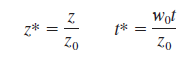

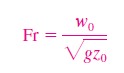
which is the desired nondimensional equation. The grouping of dimensional constants in Eq. 7–7 is the square of a well-known nondimensional parameter or dimensionless group called the Froude number,
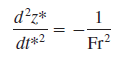
Nondimensional result:
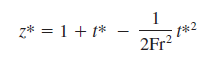
There are two key advantages of nondimensionalization . First, it increases our insight about the relationships between key parameters. Equation 8 reveals, for example, that doubling w0 has the same effect as decreasing z0 by a factor of 4. Second, it reduces the number of parameters in the problem. For example, the original problem contains one dependent variable, z; one independent variable, t; and three additional dimensional constants, g, w0, and z0. The nondimensionalized problem contains one dependent parameter, z*; one independent parameter, t*; and only one additional parameter, namely the dimensionless Froude number, Fr. The number of additional parameters has been reduced from three to one!
Example (next) : further illustrates the advantages of nondimensionalization.
Illustration of the Advantages of Nondimensionalization
Your little brother’s high school physics class conducts experiments in a large vertical pipe whose inside is kept under vacuum conditions. The students are able to remotely release a steel ball at initial height z0 between 0 and 15 m (measured from the bottom of the pipe), and with initial vertical speed w0 between 0 and 10 m/s. A computer coupled to a network of photosensors along the pipe enables students to plot the trajectory of the steel ball (height z plotted as a function of time t) for each test. The students are unfamiliar with dimensional analysis or nondimensionalization techniques, and therefore conduct several “brute force” experiments to determine how the trajectory is affected by initial conditions z0 and w0. First they hold w0 fixed at 4 m/s and conduct experiments at five different values of z0: 3, 6, 9, 12, and 15 m. The experimental results are shown in Fig. 12a. Next, they hold z0 fixed at 10 m and conduct experiments at five different values of w0: 2, 4, 6, 8, and 10 m/s. These results are shown in Fig. 12b. Later that evening, your brother shows you the data and the trajectory plots and tells you that they plan to conduct more experiments at different values of z0 and w0. You explain to him that by first nondimensionalizing the data, the problem can be reduced to just one parameter, and no further experiments are required. Prepare a nondimensional plot to prove your point and discuss.
SOLUTION A nondimensional plot is to be generated from all the available trajectory data. Specifically, we are to plot z* as a function of t*.Assumptions The inside of the pipe is subjected to strong enough vacuum pressure that aerodynamic drag on the ball is negligible. Properties The gravitational constant is 9.81 m/s2. Analysis Equation 4 is valid for this problem, as is the nondimensionalizatio that resulted in Eq. 9. As previously discussed, this problem combines three of the original dimensional parameters (g, z0, and w0) into one nondimensional parameter, the Froude number. After converting to the dimensionless variables of Eq. 6, the 10 trajectories of Fig. 12a and b are replotted in dimensionless format in Fig. 13. It is clear that all the
trajectories are of the same family, with the Froude number as the only remaining parameter. Fr2 varies from about 0.041 to about 1.0 in these experiments. If any more experiments are to be conducted, they should include combinations of z0 and w0 that produce Froude numbers outside of this range. A large number of additional experiments would be unnecessary, since all the trajectories would be of the same family as those plotted in Fig. 13. Discussion At low Froude numbers, gravitational forces are much larger than inertial forces, and the ball falls to the floor in a relatively short time. At large values of Fr on the other hand, inertial forces dominate initially, and the ball rises a significant distance before falling; it takes much longer for the ball to hit the ground. The students are obviously not able to adjust the gravitational constant, but if they could, the brute force method would require many more experiments to document the effect of g. If they nondimensionalize first, however, the dimensionless trajectory plots already obtained and shown in Fig.13 would be valid for any value of g; no further experiments would be required unless Fr were outside the range of tested values. If you are still not convinced that nondimensionalizing the equations and the parameters has many advantages, consider this: In order to reasonably document the trajectories of Example 3 for a range of all three of the dimensional parameters g, z0, and w0, the brute force method would require several (say a
minimum of four) additional plots like Fig. 12a at various values (levels) of w0, plus several additional sets of such plots for a range of g. A complete data set for three parameters with five levels of each parameter would require 53 125 experiments! Nondimensionalization reduces the number of parameters from three to one—a total of only 51 5 experiments are required for the same resolution. (For five levels, only five dimensionless trajectories like those of Fig. are required, at carefully chosen values of Fr.) Another advantage of nondimensionalization is that extrapolation to untested values of one or more of the dimensional parameters is possible. For example, the data of Example 3 were taken at only one value of gravitational acceleration. Suppose you wanted to extrapolate these data to a different value of g.

DIMENSIONS AND UNITS
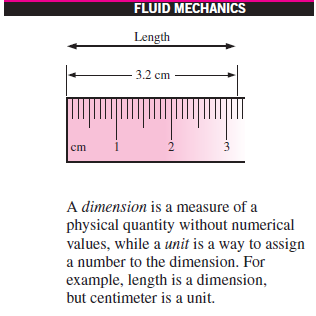
A dimension is a measure of a physical quantity (without numerical values), while a unit is a way to assign a number to that dimension. For example, length is a dimension that is measured in units such as microns ( m), feet (ft), centimeters (cm), meters (m), kilometers (km), etc. There are seven primary dimensions (also called fundamental or basic dimensions)—mass, length, time, temperature, electric current, amount of light, and amount of matter.
All nonprimary dimensions can be formed by some combination of the seven primary dimensions.
For example, force has the same dimensions as mass times acceleration (by
Newton’s second law). Thus, in terms of primary dimensions,
Dimensions of force:

where the brackets indicate “the dimensions of” and the abbreviations are taken from Table . You should be aware that some authors prefer force instead of mass as a primary dimension—we do not follow that practice.

Example : Primary Dimensions of Surface Tension An engineer is studying how some insects are able to walk on water (Fig.). A fluid property of importance in this problem is surface tension (ss), which has dimensions of force per unit length. Write the dimensions of surface tension in terms of primary dimensions.
Solution: The primary dimensions of surface tension are to be determined.
Analysis From Eq., force has dimensions of mass times acceleration, or
{mL/ t2}. Thus,
Solution: The primary dimensions of surface tension are to be determined.
Analysis From Eq., force has dimensions of mass times acceleration, or
{mL/ t2}. Thus,
Dimensions of surface tension:

Discussion The usefulness of expressing the dimensions of a variable or
constant in terms of primary dimensions will become clearer in the
discussion of the method of repeating variables in Section
constant in terms of primary dimensions will become clearer in the
discussion of the method of repeating variables in Section

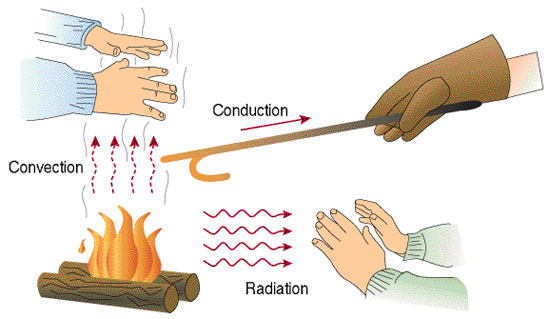
Heat transfer is a complex process which is achieved by the superposition of three fundamental modes: conduction, convection and radiation. In case one of these three modes is determining the effects of others are unimportant, so they can be neglected, greatly simplifying the analysis cases concerned. Taking into account these conditions, we will then present the mechanism of occurrence of each of these modes.
Conduction:
In areas where there is a material temperature gradient there is a mechanism of heat transfer from warm regions to cold regions that does not involve radiation or travel macroscopic matter is conduction.
In gases, the molecules that hot regions with more energy by collision with molecules of lower kinetic energy when they enter the colder regions. From a macroscopic point of view, it thus heat transfer. In liquids, the process is quite similar, but the molecules are closer, free electrons and lattice vibrations. It is thus understood that the body that are good conductors of electricity are also good conductors of heat. Similarly, good electrical insulators are good thermal insulators.
Heat output transmitted by conduction through a surface element dS located inside a material or temperature gradient is given by Fourier's law:

The general equation for conduction is obtained by writing that the heat stored during the time dt by a small volume element dV material at temperature T is equal to the heat generated in the item minus the heat lost by conduction:

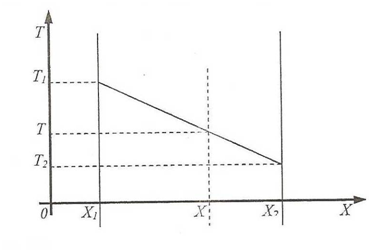
conduction in a plane wall

Ask and you Shall Receive
I know it sounds crazy, but think about it for a minute - how are you going to get what you're looking for if the people who can make it happen don't know what you want? When you go to a restaurant, do you sit at an open table and just hope that the waiter will bring you the right meal? Heck, no! So why would you expect to get any kind of promotion or special assignment at the office if you don't show interest in them?
Some Examples
In my career, I've had a few instances where simply asking for a certain role has resulted in great things for me. During undergrad, I had a co-op gig with a circuit board manufacturing company. One day, the president held a meeting for all staff to announce that the company had won a grant to start a spin-off business to design LED streetlights. I thought that was pretty cool, so I went up to the president afterwords to chat about the new project and to see if he needed help with it. As it happens, they did! I ended up being the first full-time engineer on staff and was even offered stock options to stick with the company in it's early days. All because I just asked about it! Now, I ended up turning down the offer to follow a girl across the country, but that's another story....
I had a similar experience recently with my current employer during my annual performance review. I told my boss I was interested in getting into project management and to be more involved in the leadership of engineering teams as I move forward in my career. His response was to tell me he would support me in my getting my MBA in support of those goals. It's amazing how willing people are to help you towards your goals if you make it known what those goals are.
Some Steps to Get You Started
- Decide what you want from your career - This is simple enough, right? How can you ask for support in developing yourself if you don't know what you need help achieving? This may be easier said that done, though. Maybe you're still in the early throws of your career, and you're still learning about everything an engineer can do in the fist place. That's OK, because you can ask for help figuring this out too! In my experience, if you demonstrate drive, people are very willing to help you with direction. People tend to enjoy guiding the motivated.
- Decide who to ask - Think about who's job it is to help develop you in your career. In most organizations, this is probably your direct supervisor. Think about it this way: your boss' goal should be to promote all of their employees up to his or her level. If they can do that, then they demonstrate their abilities as a leader in their own right, and can earn themselves a promotion. Make no mistake about it, part of your boss' job is to make you better at what you do, and they're looking for ways to do that. Help them out, and good things can happen.
- Decide when to ask - It might not be a fantastic idea to waltz into your manager's office randomly and proclaim "I want to be your boss some day!" If you have some kind of performance review on an annual or semi-annual basis, that would be a perfect opportunity to bring up where you'd like to go. You're already talking about where you've been in the past, why not talk about where you see yourself in the future?
Moving Forward
Have you ever asked for something at work and were surprised that
things worked out in your favour? Do you have any tips for other readers
looking to do the same? Share your experience with us in the comments
section below!About the Author
Pat Sweet is an Electrical Engineer in Training in Ontario, Canada. He’s a full-time designer of all-electric trains and the author behind the Engineering and Leadership blog, where he shares his thoughts and experiences on leadership, productivity, and career advice for young engineers.